

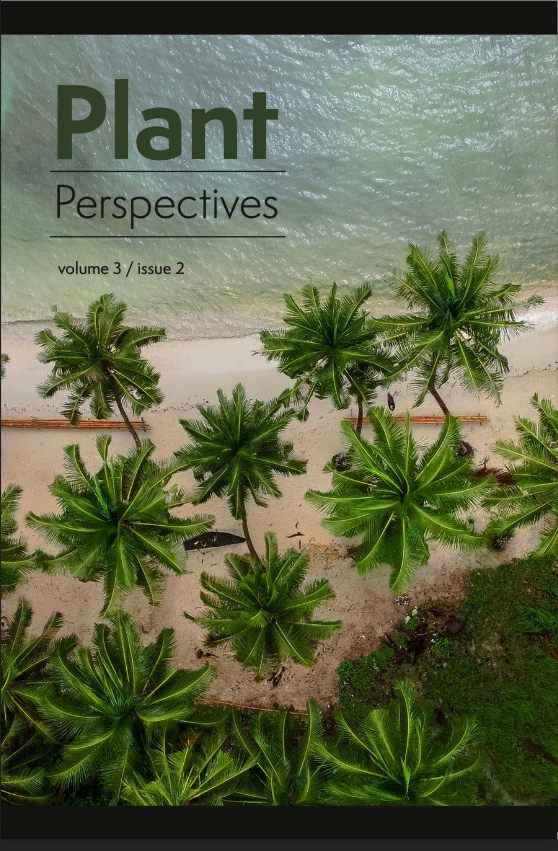
Published 2026-09-16
Keywords
- Palms,
- Ecuador,
- Uses,
- Chontaduro,
- Salak
How to Cite
Copyright (c) 2026 Alejandro Solano-Ugalde, Pilar Egüez Guevara, Agustina Arcos-Torres

This work is licensed under a Creative Commons Attribution 4.0 International License.
Abstract
For its outstanding biodiversity Ecuador has been designated as one of ten megadiverse countries. Due to its location on the equator, it enjoys many climates, soils and diverse geological processes. In Ecuador, palms represent the group of native plants with the greatest diversity of uses per species. At the Mashpi Shungo Reserve in the Ecuadorian northwest, the authors have been working to restore degraded areas using regenerative practices through diverse agroforestry systems. We have explored working with a diversity of palms. To date, eighteen species of palms of 36 varieties have been used in restoration, which we have integrated with about 300 species of other plants. In this manuscript we report the mostly edible uses of these palms, focusing on the current and potential uses of two palm species, Bactris gasipaes and Salacca zalacca.
References
- Balick, M.J. and H. Beck. 1990. Useful Palms of the World: A Synoptic Bibliography. New York: Columbia University Press.
- Correa-Neto, N.E., N. Maranhao-Messerschmidt, W. Steenbock and P. Facina-Monnerat. 2016. ‘Agroforesting the world from the machete to the tractor: Generating agroforestry praxis in a network’. Cooperafloresta. http://www.cooperafloresta.com.br (accessed 14 August 2025).
- Freile, J.F. 2020. ‘Lo que duele del palmito: Historias de vida de un cultivo tropical’. Ecuador Terra Incognita 120: 8–16.
- González-Jaramillo, N., N. Bailon-Moscoso, R. Duarte-Casar and J.C. Romero-Benavides. 2022. ‘Peach palm (Bactris gasipaes Kunth.): Ancestral tropical staple with future potential’. Plants 11: 3134. https://doi.org/10.3390/plants11223134
- Henderson, A., G. Galeano and R. Bernal. 2019. Field Guide to the Palms of the Americas. Princeton: Princeton University Press.
- Riffle, R.L., P. Craft and S. Zona. 2012. The Encyclopedia of Cultivated Palms. Second edition. Portland, OR: Timber Press.
- Sallon, S., E. Solowey, Y. Cohen, R. Korchinsky, M. Egli, I. Woodhatch and M. Kislev. 2008. ‘Germination, genetics, and growth of an ancient date seed’. Science 320 (5882): 1464. https://doi.org/10.1126/science.1153600
- Senanayake, R. 1987. ‘Analog forestry as a conservation tool’. Tiger Paper. Bangkok: FAO.
- Steenbock, W., L. da C.e Silva, R.O. da Silva, A.S. Rodrigues, J. Perez-Cassarino and R. Fonini. 2013. Agrofloresta, ecologia e sociedade [Agroforestry, ecology and society]. Curitiba, PR: Kairós.
- Valencia, R., R. Montúfar, H. Navarrete and H. Balslev (eds). 2013. Palmas ecuatorianas: Biología y uso sostenible. Quito: Publicaciones del Herbario QCA, Pontificia Universidad Católica del Ecuador.
- West, J. and A. Solano. 2021. Libro vivo de la tropicultura. Proyecto Factorías del Conocimiento en la Mancomunidad del Chocó Andino. Quito: Fundación Imaymana, AEXCID, AUPEX.
- West, J. and A. Solano. 2023. Libro vivo de la tropicultura. Vol. 2. Proyecto RestaurAcción – Bosque Modelo Chocó Andino. Quito: Fundación Imaymana, Gobierno de Canadá.