

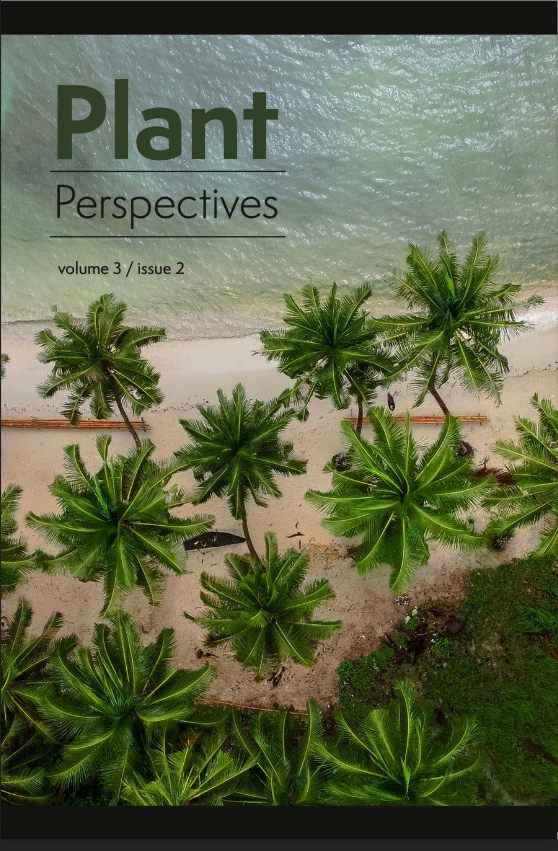
Published 2026-09-16
Keywords
- coconut palm,
- oil palm plantations,
- red ring disease,
- bud rot disease,
- picudo negro
How to Cite
Copyright (c) 2026 Andrés Caicedo

This work is licensed under a Creative Commons Attribution 4.0 International License.
Abstract
The South American Palm Weevil (Picudo negro) is my ethnographic entry point to study the racialised relations between oil palm and coconut palm in Tumaco, a municipality located on the Colombian South Pacific Coast. Oil palm agricultural scientists, small farmers and companies, and coconut palm experts and growers have blamed picudo negro as the primary culprit for the most damaging plant diseases affecting these trees in Colombia: bud rot disease (oil palm) and red ring disease (coconut palm). They have caused the near collapse of both oil and coconut crops in Tumaco. By following picudo negro's traces, this paper argues that plant health measures to treat coconut and oil palm diseases operate as racialised technologies. Even though oil and coconut palms in Tumaco share the fact of undergoing lethal epidemics, they have experienced ruin, death, mourning, treatment and reparation differently. While oil palm plantations have received much attention, care and research from experts and national institutions, coconut palm ecologies have experienced systematic abandonment. I thus examine how the salvation of the oil palm, as the most ‘promising’ national (mono)crop, entails the erasure and eradication of the black ecologies, agriculture and knowledge stemming from the coconut palm trees.
References
- Aldana de la Torre, R.C., J.A. Aldana de la Torre, O.M. Moya, T.Pretelt, P. Bozzi, P., Navia, E… and G. Martínez. 2010. Biología, hábitos y manejo de Rhynchophorus palmarum L. (Coleoptera: Curculionidae) (Boletín Técnico No. 23). Centro de Investigación en Palma de Aceite - Cenipalma. https://www.cenipalma.org.
- Aldana de la Torre, R.C., H. Gomes de Oliveira, Centro de Investigación en Palma de Aceite Cenipalma and Servicio Nacional de Aprendizaje SENA. 2010. Implementación de técnicas de manejo de Rhynchophorus palmarum. Cenipalma. http://repositorio.fedepalma.org/handle/123456789/107675
- Aldana de la Torre, R.C., J.A. Aldana de la Torre, O.M. Moya and A.E. Bustillo Pardey. 2015. El Anillo rojo en palma de aceite. Boletines técnicos, (36): https://publicaciones.fedepalma.org/index.php/boletines/article/view/11070
- Berman-Arévalo, E. 2019. ‘Mapping violent land orders: armed conflict, moral economies, and the trajectories of land occupation and dispossession in the Colombian Caribbean’. The Journal of Peasant Studies 48 (2): 349–67.
- https://doi-org.libproxy.berkeley.edu/10.1080/03066150.2019.1655640
- Butler, J. 2010. Frames of War : When is Life Grievable?. London: Verso.
- Carney, J.A. 2001. ‘Black rice’. In Black Rice. Cambridge, MA: Harvard University Press.
- Carney, J.A. 2021. ‘Subsistence in the Plantationocene: Dooryard gardens, agrobiodiversity, and the subaltern economies of slavery’. The Journal of Peasant Studies. 48 (5): 1075–99.
- Chao, S. 2022a. In the Shadow of the Palms: More-than-human Becomings in West Papua. Durham, NC: Duke University Press.
- Chao, S. 2022b. ‘(Un)worlding the Plantationocene: Extraction, extinction, emergence’. eTropic 21 (1): 165–91.
- Chao, S. (2022c) ‘Plantation’, Environmental Humanities 14 (2): 361–66.
- Erevelles, N. 2011. Disability and Difference in Global Contexts: Enabling a Transformative Body Politic. New York: Palgrave Macmillan.
- Fedepalma. 2002. ‘Plan Colombia le apuesta a la palma de aceite’. El Palmicultor (September).
- Fedepalma. 2014. ‘La palma es la salvación; la coca, no’. El Palmicultor (April).
- Fedepalma. 2016. Palmicultura en Tumaco: Acciones prioritarias para su reactivación y desarrollo sostenible. Propuesta de Fedepalma (Versión 5). Fedepalma.
- Ferrand, M. 1959. Informe sobre la misión en Colombia del 1 de julio de 1958 al 30 de junio de 1959. IFA. Colombia
- Ferrand, M. 1964. General Information on Oil-palm Cropping in the Tropics: Possibilities of the Colombian Agricultural Sector. IFA. Colombia
- Fuentes, M.J. 2016. Dispossessed Lives: Enslaved Women, Violence, and the Archive. Pitssburgh: University of Pennsylvania Press. http://www.jstor.org/stable/j.ctt1c5chbv
- Gumbs, A.P. 2020. Undrowned: Black Feminist Lessons from Marine Mammals. Chico, CA: AK Press.
- Hartman, S.V. 2019. Wayward Lives, Beautiful Experiments: Intimate Histories of Social Upheaval (First ed.). New York: W.W. Norton & Company.
- Hartman, S. 1997. Scenes of Subjection: Terror, Slavery, and Self-Making in Nineteenth-Century America. New York: Oxford University Press.
- Instituto de Fomento Algodonero. Boletín de Divulgación. 16 and 17 (Sept. / Oct. 1959).
- Incora. Proyecto de colonización con base en plantaciones de palma africana. Bogotá, noviembre 5 de 1962. p. 1. (mimeographed document).
- Instituto de Fomento Algodonero. Estudios para el cultivo de la Palma en el Pacífico Nariñense, sección de Oleaginosas. Boletín de extensión 7 (Dec. 1963).
- Instituto de Fomento Algodonero. Posibilidades para el cultivo de la Palma en Colombia. Sección de Oleaginosas. Boletín de extensión 4 (Dec. 1960).
- Instituto Colombiano Agropecuario (ICA), Instituto Colombiano de la Reforma Agraria, & Caja de Crédito Agrario Industrial y Minero. 1973. Subproyecto integrado de sanidad y producción del coco [Report]. Bogotá, Colombia. http://hdl.handle.net/20.500.12324/23900
- Instituto Colombiano Agropecuario. 1975. Coco: Enfermedades de las plantas, planificación y flujo de la información [Report]. Instituto Colombiano Agropecuario.
- Instituto Colombiano Agropecuario. 1978. Programa de oleaginosas perennes Informe de progreso 1978–1979. Instituto Colombiano Agropecuario.
- Jackson, Z. 2020. Becoming Human. Matter and Meaning in an Antiblack World. New York: New York University Press.
- King, T. L. 2019. The Black Shoals: Offshore Formations of Black and Native Studies. Durham NC: Duke University Press.
- Leal, C. and E. Restrepo. 2003. Unos bosques sembrados de aserríos: Historia de la extracción maderera en el Pacífico colombiano. Colciencias – ICANH, Colección Clío, Convenio Universidad de Antioquia – Universidad Nacional de Colombia, Sede Medellín, Facultad de Ciencias Humanas y Económicas.
- Leal, C. 2018. Landscapes of Freedom: Building a Postemancipation Society in the Rainforests of Western Colombia. Tucson: University of Arizona Press.
- Livingston, J. 2005. Debility and the Moral Imagination in Botswana. Bloomington: Indiana University Press.
- Lohr, B.L. 2016. Manual de cría del picudo negro de las palmas, Rhynchophorus palmarum. Corporación Colombiana de Investigación Agropecuaria - AGROSAVIA.
- McKittrick, K. 2006. Demonic Grounds: Black Women and the Cartographies of Struggle. Minneapolis: University of Minnesota Press.
- McKittrick, K. 2013. ‘Plantation futures’. Small Axe 17 (3): 1–15.
- Melamed, J. 2015. ‘Racial capitalism’. Critical Ethnic Studies 1 (1): 76–85.
- Melamed, J. 2011. Represent and Destroy: Rationalizing Violence in the New Racial Capitalism. Minneapolis: University of Minnesota Press.
- Ojeda, D. 2016. ‘Los paisajes del despojo: Propuestas para un análisis desde las reconfiguraciones socioespaciales’. Revista Colombiana de Antropología 52 (2): 81–100. https://doi.org/10.22380/2539472X38
- Pérez Rojas, P.A. (Comp.) 2012. Guía de prácticas agrícolas en el cultivo de palma de aceite ya establecido. Federación Nacional de Cultivadores de Palma de Aceite (Fedepalma). https://www.fedepalma.org
- Plaza Mora, J.E. 1976. Cocos nucifera: Control de enfermedades y medios de comunicación de masas [Report]. Instituto Colombiano Agropecuario. http://hdl.handle.net/20.500.12324/23900
- Plaza Mora, J.E. 1977. Cocos nucifera: Control de enfermedades e infecciones por nematodos [Report]. Universidad Nacional de Colombia.
- Prieto, G. 2016. ‘Colonización empresarial y concentración de tierra: El cultivo de palma en Tumaco (1960–1990)’. Unpublished Ph.D. thesis, ICANH.
- Puar, J.K. 2017. The Right to Maim: Debility, Capacity, Disability. Durham NC: Duke University Press.
- Puar, J.K. 2009. ‘Prognosis time: Towards a geopolitics of affect, debility and capacity’. Women and Performance: A Journal of Feminist Theory 19 (2): 161–72.
- Quintero, J. 2010. ‘Dinámica de captura de adultos de Rhynchophorus palmarum L. (Coleóptera: Curculionidae) en la red de monitoreo de la Zona Occidental’. Palmas 31: 17–27.
- Roane, J.T. 2018. ‘Black ecologies in the Atlantic world: From the swamp to the shoal’. Environmental History 23 (3): 542–67.
- Roussi-Césaire, S. 2009. [1943] ‘1943: Le surrealisme et nous’. In D. Maximin (ed.) Le grand camouflage. Écrits de dissidence (1941–1945), pp. 76–83. Paris: Éditions du Seuil.
- Roussi-Césaire, S. 2009. [1945] ‘Le grand camouflage’. In D. Maximin (ed.) Le grand camouflage. Écrits de dissidence (1941–1945), pp. 84–94. Paris: Éditions du Seuil.
- Roussi-Césaire, S. 2009. [1942] ‘Malaise d’une civilisation’. In D. Maximin (ed.) Le grand camouflage. Écrits de dissidence (1941–1945), pp. 67–75. Paris: Éditions du Seuil.
- Roussi-Césaire, S. 2009. [1942] ‘Misère d’une poésie. Jhon-Antoine-Nau’. In D. Maximin (ed.) Le grand camouflage. Écrits de dissidence (1941–1945), pp. 63–66. Paris: Éditions du Seuil.
- Robinson, C.J. 2000. [1983]) Black Marxism: The Making of the Black Radical Tradition. Chapel Hill, NC: University of North Carolina Press.
- Sánchez Potes, A. 1967. El anillo rojo (radinaphelenchus cocophilus) del cocotero en la zona de Tumaco (Nariño) / por Alberto Sánchez Potes. Bogotá: Instituto de Fomento Algodonero.
- Sánchez Potes, A. 1975. El cultivo del cocotero. Bogotá: Instituto Colombiano Agropecuario.
- Sanz Scovino, J.I. 2016. ‘Las mejores prácticas agroindustriales para una excelente palmicultura colombiana’. Revista Palmas. https://publicaciones.fedepalma.org
- Serrano Zapata, A. 2021. The Power of Oil Palm: Violence, Inequality and Alternatives in Colombia. Ph.D. diss. University of Wisconsin-Madison.
- Taylor, S. 2024. Disabled Ecologies: Lessons from a Wounded Desert. Oakland: University of California Press. https://doi.org/10.2307/jj.14416319
- Thomas, D.A. 2019. Political Life in the Wake of the Plantation: Entanglement, Witnessing, Repair. Durham, NC: Duke University Press.
- Weheliye, A.G. 2014. Habeas viscus: Racializing Assemblages, Biopolitics, and Black Feminist Theories of the Human. Durham NC: Duke University Press.
- Wolford, W. 2021. ‘The Plantationocene: A Lusotropical contribution to the theory’. Annals of the American Association of Geographers 111 (6): 1622–39.
- Wynter, S. 1971. ‘Novel and history, plot and plantation’. Savacou 5: 95–102.