
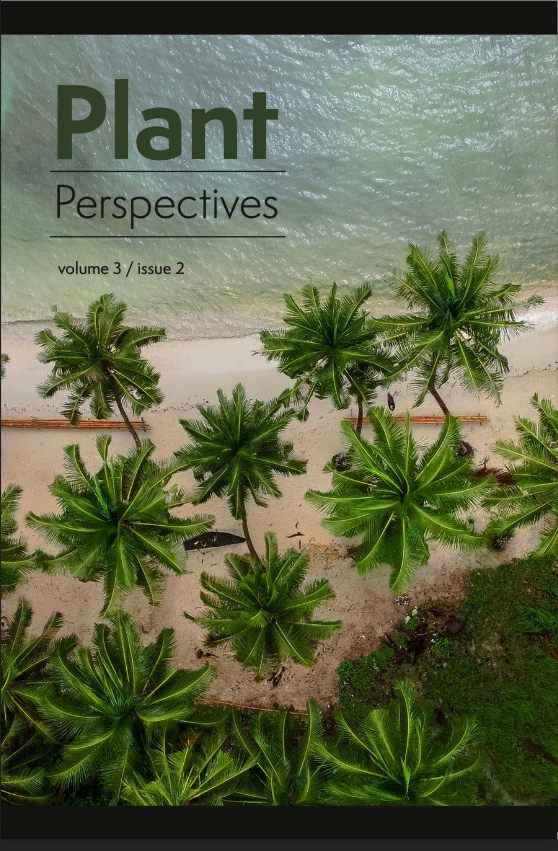
Published 2026-09-16
Keywords
- Coconuts,
- Palms,
- Philippines,
- United States,
- History
How to Cite
Copyright (c) 2026 Theresa Ventura

This work is licensed under a Creative Commons Attribution 4.0 International License.
Abstract
This photo essay filters the Philippine copra industry through the lens of the cropscape, a mode of understanding the multiple assemblages and timescales by which rooted plants become mobile. One key story in this assemblage is Imelda Marcos's Tahang Pilipino – a model ‘Filpino home’ purportedly built exclusively out of coconut materials at the dawn of her husband's martial law regime and today popularly known as a ‘the Coconut Palace’. By approaching the Tahanang as a mid- to late-twentieth century iteration of a longer visual culture of coconut palm extraction, we see how Imelda Marcos’s imagined coconut future was deeply rooted in the extractive logics of a Euro-American colonialism that divided the globe into a temperate North and tropical South. The Tahanang Pilipino, I argue, modernised and nationalised a colonial history by naturalising the Philippines as a producer of tropical commodities for global consumption.
References
- Alzate, M.A. 1926. Convict Labor in the Philippine Islands: Presented at the Ninth International Prison Congress Held in London, August 1925. Manila: Bureau of Printing.
- Barney, K. 2009. ‘Laos and the making of a “relational” resource frontier’. The Geographical Journal 175 (2): 146–59.
- Barrett, O.W. 1911. ‘Coconut conditions in Laguna’. Philippine Agricultural Review 4 (3): 151–53.
- Bennett, J. (ed.) 2018. ‘Pacific coconut: Comestible, Comfort and Commodity’. Special Issue. Journal of Pacific History 53 (4).
- BillionBricks. n.d. ‘Spotlight: Coconut palace’: https://billionbricks.org/blog/spotlight-coconut-palace/ (accessed 16 Oct. 2024).
- Bray F., B. Hahn, J.B. Lourdusamy and T. Saraiva. 2023. Moving Crops and the Scales of History. New Haven: Yale University Press.
- Brescius, M. von. 2025. ‘The “mobile plantation” of Charduar: Local connections, imperial portfolios, and the global pathways of Assam rubber’. In N. Miller and U. Linder (eds), Plantation Knowledge: Agricultural Knowledge, Exploitation, and Change Since 1500. Albany: State University of New York Press. pp. 145–80.
- Cerepak, P.J. 2020. ‘Establishing the intimate link: 20th century tropical agriculture and the establishment of the coconut zone’. Journal of Maritime Studies and National Integration 4 (1): 1–11.
- Cerepak, P.J. 2016. ‘Coconuts: catalyst of conflict’. Edge Effects, 5 April: https://edgeeffects.net/coconuts-conflict/
- Copeland, E.B. 1914. The Coco-nut. London: Macmillan and Co.
- De Leon, A. 2023. Bundok: A Hinterland History of the Philippines. Chapel Hill: University of North Carolina Press.
- Driver F. and L. Martins. 2005. Tropical Visions in an Age of Empire. Chicago: University of Chicago Press.
- Droessler, H. 2022. Coconut Colonialism: Workers and the Globalization of Samoa. Cambridge, MA: Harvard University Press.
- Hanley, T.P. 1902. ‘Notes on agriculture in Ceylon and on the Botanical Gardens at Peradeniya’. In Report of the Philippine Commission, pp. 630–33. Manila: Bureau of Public Printing.
- ‘Heavy rainfall causes trouble in Palawan’. 1910. Cablenews-American (Manila), 21 December.
- Iwahig Creation Act. 1904. Acts of Commission No. 1723. Reprinted in Cablenews-American, 4 October.
- ‘Iwahig colony is one of greatest penal reforms’. 1911. Cablenews-American (Manila), 27 August.
- Kramer, P.A. 2006. Blood of Government: Race, Empire, the United States and the Philippines. Chapel Hill: University of North Carolina Press.
- Laurance, R. 2019. Coconut: How the Shy Fruit Shaped the World. Stroud, UK: The History Press, Limited.
- Lico, G. 2003. Edifice Complex: Power, Myth, and Marcos State Architecture. Quezon City: Ateneo de Manila Press.
- Lyon, W. 1903. The Cocoanut: With Reference to its Products and Cultivation in the Philippines. Manila: Bureau of Printing.
- Martinez, D. 2022. ‘From rice research to coconut capital’. In Aggregate Architectural History Collaborative (ed.) Architecture in Development: Systems and the Emergence of the Global South. London: Routledge.
- McKinley, W. 1900. ‘State of the Union’. 3 December. http://www.let.rug.nl/usa/presidents/william-mckinley/state-of-the-union-1900.php
- Miller, K.R. 2024. ‘Agents of the settler state: Incarcerated Filipino workers, conjugal migration, and Indigenous dispossession at the Iwahig Penal Colony’. American Quarterly 76 (1): 25–53.
- Mojares, R.B. 1985. ‘Worcester in Cebu: Filipino response to American business, 1915–1924’. Philippine Quarterly of Culture & Society 13 (1): 1–13.
- Moore, O.K. 1948. ‘The coconut palm: Mankind’s greatest provider in the tropics’. Economic Botany 2 (2): 119–44.
- Reeves Evison, T. 2024. ‘On prospecting: visual culture between extraction and speculation’. Environmental Humanities 16 (3): 603–23.
- Rice, M. 2013. Dean Worcester’s Fantasy Islands: Photography, Film, and the Colonial Philippines. Ann Arbor: University of Michigan Press.
- Rodriguez R.M. 2010. Migrants for Export: How the Philippine State Brokers Labor to the World. Minneapolis: University of Minnesota Press.
- Snodgrass, K. 1928. Copra and Coconut Oil. Palo Alto: Stanford University Press.
- Tiglao, R. 1983. ‘The political economy of the Philippine coconut industry’. In R.S. David (ed.) Political Economy of Philippine Commodities. Quezon City: University of the Philippines Press. pp. 181–272.
- Tsing, A.L. 2003. ‘Natural resources and capitalist frontiers’. Economic and Political Weekly 38 (48): 5100–106.
- United States Senate, Subcommittee of the Committee on Finance. 1942. S. 2079: A Bill to Authorize the Condemnation of Materials which are Intended for Use in Process or Renovated Butter and which are Unfit for Human Consumption, and for Other Purposes. 77th Cong., 2nd sess. Washington, DC: Government Printing Office.
- Ventura, T. 2025. ‘Copra and conquest’. In N. Miller and U. Linder (eds), Plantation Knowledge: Agricultural Knowledge, Exploitation, and Change Since 1500. Albany: State University of New York Press. pp. 245–72.
- Ventura, T. 2022. ‘Consider the coconut: Scientific agriculture and the racialization of risk in the American Colonial Philippines’. Journal of Transnational American Studies 13 (1): 45–67.
- White, J.R. 1928. Bullets and Bolos: Fifteen Years in the Philippine Islands. N.p.: Constabulary Books.
- Wilson. 1903. ‘Wilson to Lamson-Scribner, October 17, 1903’. Box 1: Letter books, 1888–1903, Vol. 3. F. Lamson-Scribner Papers, Manuscript Division, Library of Congress.